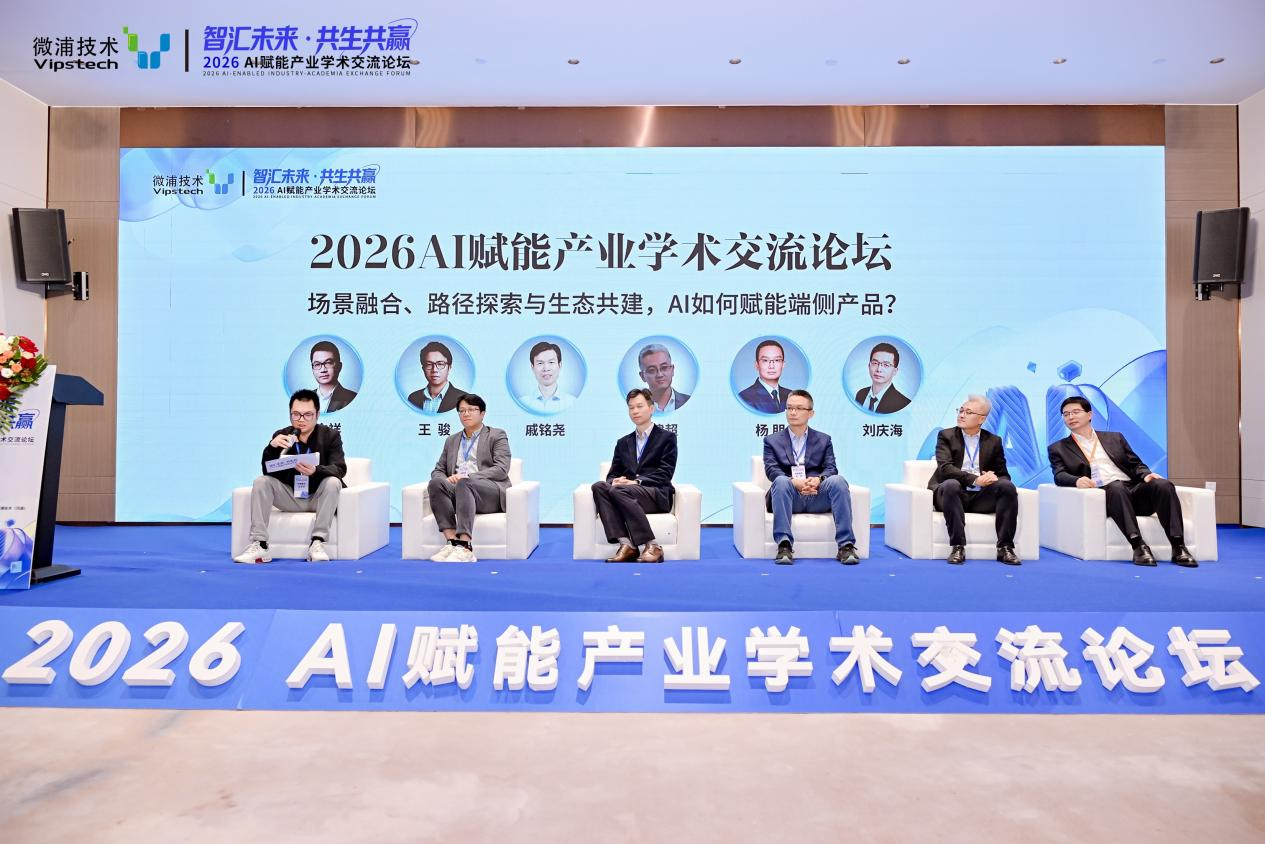
This afternoon, the “Future in Wisdom, Win-Win in Symbiosis — 2026 AI Empowering Industry Academic Forum” was held in Nanshan District, Shenzhen. Hosted by Vipstech, a national high-tech enterprise based in Shenzhen, the forum focused on the deep integration of artificial intelligence and the real economy. Nearly one hundred representatives from government departments, universities, research institutes, industry leaders and investment institutions gathered to discuss technology evolution and industrial collaboration under the “AI + Manufacturing” trend, adding fresh momentum to Shenzhen’s ambition of becoming a hub for AI and intelligent manufacturing.
The forum centered on three major themes aligned with industry trends. First, participants discussed how AI can accelerate manufacturing transformation and upgrade, exploring practical pathways and future forms of intelligent manufacturing. Second, the event examined breakthroughs and application innovation in edge AI, with a focus on core scenarios such as smart audiovisual solutions and intelligent storage. Third, attendees explored collaborative innovation mechanisms led by enterprises, supported by universities and strengthened by deep capital participation. Within these topics, guests shared the latest progress in areas including AI super-resolution, intelligent voice interaction, edge storage with AI collaboration, data security and privacy protection.
During the forum, several leading experts from academia and industry delivered keynote speeches. Qi Mingyao, Professor at Tsinghua University and a nationally recognized leading talent, introduced frontier progress in the integration of AI with engineering systems through complex system modeling and operations optimization. Wang Jun, Visiting Professor at Columbia University and Chief Architect at Alibaba DAMO Academy, provided a systematic interpretation of the technical characteristics of edge-side foundation models and their path toward large-scale deployment. Zhao Jianchao, Head of Wired Product Planning at ZTE, analyzed how AI is reshaping traditional manufacturing systems based on industrial practice in communications equipment. Representatives from the Nanshan District government and investment institutions including CCCC Capital also attended and joined the discussions.
From the government perspective, Li Juan, Deputy Director of the Nanshan District Bureau of Industry and Information Technology, said in her remarks that the forum’s focus on the deep integration of AI and industrial manufacturing is highly aligned with Nanshan’s forward-looking strategy of developing the AI industry and promoting coordinated integration across the innovation chain, industrial chain, capital chain and talent chain. She noted that Nanshan is continuously strengthening its AI industrial ecosystem by improving policy support, building innovation platforms and expanding access to application scenarios. High-quality industry exchange platforms such as this forum will further accelerate the transformation of technological achievements into real productive forces.
Li Juan, Deputy Director of the Nanshan District Bureau of Industry and Information Technology, delivered a keynote address.
From an industry perspective, the forum also reflected Shenzhen manufacturing’s accelerating shift toward intelligent manufacturing. A new generation of technologies represented by edge AI is driving product upgrades and value reconstruction across leading sectors such as smart terminals and intelligent devices. As the organizer of the forum, Vipstech has continued to expand its investment in AI hardware, edge computing and manufacturing capability upgrades in recent years, making its development path a representative example of how Shenzhen’s private technology companies are achieving high-quality transformation through technological innovation.
Lively exchanges between speakers and the audience reflected strong resonance across viewpoints. Industry observers believe the successful forum further strengthened Shenzhen’s collaborative atmosphere in integrating AI with the real economy, helping to foster positive interaction among frontier technologies, industrial capital and manufacturing systems while offering important practical direction for sustained innovation and high-quality industrial development.